beats365官方唯一入口
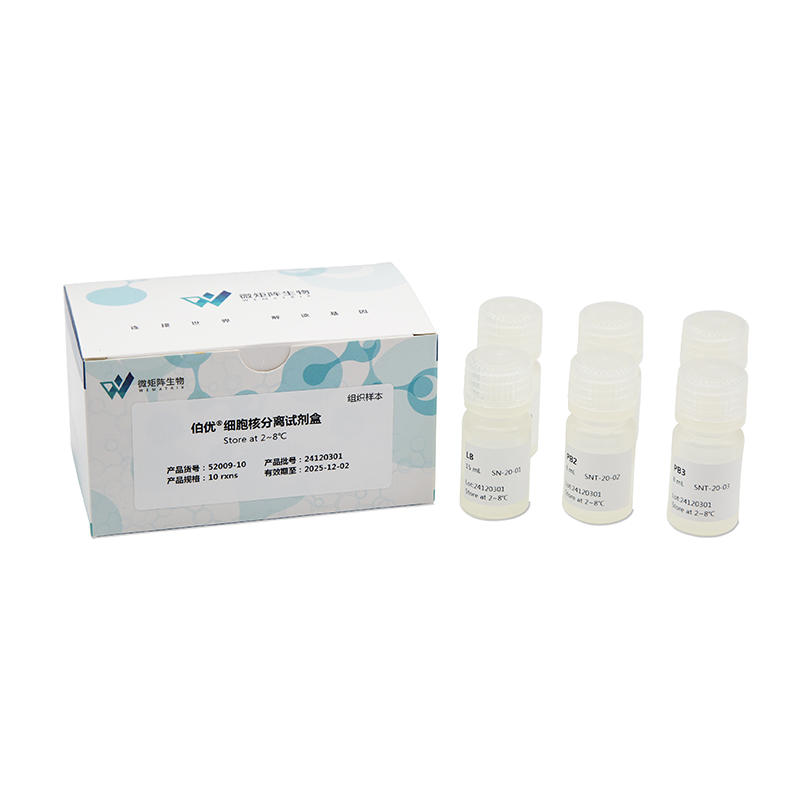
伯优®细胞核分离试剂盒
®" data-en="BioYou®">伯优® 科研专用

伯优®细胞核分离试剂盒

伯优®Nuclei Isolation Kit

产品货号
产品规格
产品用途 本产品专为从动物组织中分离高纯度的单细胞核而设计。
保存条件 2~8℃避光保存
目录价 3199
数量
说明书 在线咨询

产品简介

本产品专为从动物组织中分离高纯度的单细胞核而设计。组织通过匀浆、裂解细胞膜等步骤释放完整细胞核,同时维持核膜稳定性及染色质空间结构,优化的密度梯度离心技术可进一步去除细胞碎片和杂质,从而可满足下游单细胞组学、表观遗传学等前沿研究领域对细胞核的质量要求。

 应用范围

制备的细胞核悬液可用于核转录组学(如 snRNA-seq/bulk RNA-seq),表观遗传学(如scATAC- seq/bulk ATAC- seq,CUT&Tag)等研究。


镜检图

52009-1

应用实例

伯优®细胞核分离试剂盒已成功应用于近20个物种的细胞核分离,涵盖人、小鼠、大鼠等哺乳动物及扇贝、海葵等无脊椎动物。在组织适配性方面,本试剂盒已用于包括脑、肝脏、心脏、肺、肾、脾及各类肿瘤等200余种组织,累计20,000余例样本的细胞核悬液制备。为单细胞核RNA测序提供了稳定可靠的细胞核分离解决方案。


单细胞核RNA测序实测组织类型

52009-2


English Translation

This product is specially designed to isolate high-purity single nuclei from animal tissues. Intact nuclei are released through tissue homogenization and cell membrane lysis, while the nuclear membrane stability and spatial structure of chromatin are well preserved. The optimized density gradient centrifugation effectively removes cell debris and contaminants, enabling the nuclei to meet strict quality requirements for cutting-edge research including single-cell omics and epigenetics.

Applications

The prepared nuclear suspension is applicable to nuclear transcriptomics (e.g., snRNA-seq, bulk RNA-seq) and epigenetics research (e.g., scATAC-seq, bulk ATAC-seq, CUT&Tag).

Microscopy Images

52009-1

Application Cases

Boyou® Nucleus Isolation Kit has been successfully used for nucleus extraction from nearly 20 species, including mammals such as humans, mice and rats, as well as invertebrates like scallops and sea anemones. It is compatible with over 200 tissue types including brain, liver, heart, lung, kidney, spleen and various tumor tissues, with more than 20,000 sample preparations completed so far. It provides a stable and reliable solution for single-nucleus RNA sequencing.

Tested Tissue Types for Single-Nucleus RNA Sequencing

52009-2

应用文献

1.Zhang L, Ma J, Zhang J, et al. Radiotherapy-Associated Cellular Senescence and EMT Alterations Contribute to Distinct Disease Relapse Patterns in Locally Advanced Cervical Cancer. Adv Sci (Weinh). Published online February 4, 2025.(IF: 14.3)


2.Ji J, Ding K, Cheng B, et al. Radiotherapy-Induced Astrocyte Senescence Promotes an Immunosuppressive Microenviron ment in Glioblastoma to Facilitate Tumor Regrowth. Adv Sci (Weinh). 2024;11(15):e2304609. (IF: 14.3)


3.Lv D, Liu A, Yi Z, et al. Neuroligin 1 Regulates Autistic-Like Repetitive Behavior through Modulating the Activity of Striatal D2 Receptor-Expressing Medium Spiny Neurons. Adv Sci (Weinh). 2025;12(5):e2410728. (IF: 14.3)


4.Sun W, Zhu Y, Zou Z, et al. An advanced comprehensive muti-cell-type-specific model for predicting anti-PD-1 therapeutic effect in melanoma. Theranostics. 2024;14(5):2127-2150. Published 2024 Mar 3.(IF: 12.4)


1.Zhang L, Ma J, Zhang J, et al. Radiotherapy-Associated Cellular Senescence and EMT Alterations Contribute to Distinct Disease Relapse Patterns in Locally Advanced Cervical Cancer. Adv Sci (Weinh). Published online February 4, 2025.(IF: 14.3) 2.Ji J, Ding K, Cheng B, et al. Radiotherapy-Induced Astrocyte Senescence Promotes an Immunosuppressive Microenviron ment in Glioblastoma to Facilitate Tumor Regrowth. Adv Sci (Weinh). 2024;11(15):e2304609. (IF: 14.3) 3.Lv D, Liu A, Yi Z, et al. Neuroligin 1 Regulates Autistic-Like Repetitive Behavior through Modulating the Activity of Striatal D2 Receptor-Expressing Medium Spiny Neurons. Adv Sci (Weinh). 2025;12(5):e2410728. (IF: 14.3) 4.Sun W, Zhu Y, Zou Z, et al. An advanced comprehensive muti-cell-type-specific model for predicting anti-PD-1 therapeutic effect in melanoma. Theranostics. 2024;14(5):2127-2150. Published 2024 Mar 3.(IF: 12.4)

产品问答

Q: 52009和52201都是针对组织样本通用款,两款抽核试剂盒流程及原理、起始量方面有什么区别?
A: 两款试剂盒基本操作流程均为:组织匀浆及细胞裂解、碎片去除、清洗、重悬细胞核。52009通过密度梯度法去除碎片及杂质,获得的细胞核纯度高;52201柱提法通过过滤柱及碎片去除液去除碎片及杂质,操作流程短,得率高。建议起始量为20-50mg,52201兼容10mg以下低起始量。


Q: 52009试剂盒单次测试需要多少组织?组织研磨用什么方法?
A:组织起始量建议20-50mg,研磨方法可根据组织类型选择电动匀浆仪研磨或研磨杵手动研磨。


Q: 小鼠肝抽核,后续做ATAC-seq。新鲜与冰冻组织后续是否有区别?是否有方法能保存新鲜组织?
A: 相对来说新鲜组织更好,冰冻组织液也可以做。单细胞测序组织保存液(伯优,21903)可在72h内保持组织细胞活性。


Q: 52009处理冰冻组织和新鲜组织都可以吗?
A: 新鲜和冰冻组织都可以的。


Q: 肿瘤样本,后续单细胞转录组,推荐用什么研磨匀浆方法?
A:推荐使用电动匀浆仪(Omni TH 手持/台式两用均质器)低转速研磨5-10s。


Q: 分离细胞核的组织可以冻融几次?
A: 分离的细胞核不建议冻融,建议半小时内进行后续实验。


Q: 某些样本匀浆无法完全匀浆,如何改善?
A: 可先用剪刀剪碎组织,再进行匀浆。大部分组织匀浆即可,过度匀浆也会影响细胞核形态及得率。


Q: Both 52009 and 52201 are general kits for tissue samples. What are the differences between them in workflow, principle and initial sample amount?
A: The basic workflow of both kits includes tissue homogenization & cell lysis, debris removal, washing and nucleus resuspension. Kit 52009 removes debris and impurities via density gradient method, delivering nuclei with high purity. Kit 52201 adopts column-based purification using filter columns and debris removal solution, featuring a shorter workflow and higher yield. The recommended initial sample amount is 20–50 mg. Kit 52201 is also compatible with low-input samples below 10 mg.


Q: How much tissue is required for a single test with Kit 52009? What methods are available for tissue grinding?
A: The recommended initial tissue amount is 20–50 mg. Either an electric homogenizer or a manual pestle can be used for grinding, depending on tissue type.


Q: For nucleus extraction from mouse liver samples followed by ATAC-seq, are there any differences between fresh and frozen tissues? Is there a solution to preserve fresh tissues?
A: Fresh tissues are preferred, while frozen tissues are also applicable. Single-cell Tissue Preservation Solution (Boyou, Cat. 21903) can maintain cellular activity for up to 72 hours.


Q: Can Kit 52009 be used for both frozen and fresh tissues?
A: Yes, it works for both fresh and frozen tissues.


Q: For tumor samples intended for subsequent single-cell RNA-seq, which grinding and homogenization method is recommended?
A: Use an electric homogenizer (Omni TH Handheld/Benchtop Homogenizer) at low speed for 5–10 seconds.


Q: How many freeze-thaw cycles are allowed for isolated nuclei?
A: Repeated freeze-thaw of isolated nuclei is not recommended. Subsequent experiments should be performed within half an hour.


Q: How to improve incomplete tissue homogenization for certain samples?
A: Cut the tissue into small pieces with scissors prior to homogenization. Moderate homogenization is sufficient; excessive homogenization will impair nucleus morphology and yield.

Baidu
sogou
